Armenia

Yerevan, the Monasteries and the Mountain South

Duration
12 days
Trip style
Nature/ Hiking
Effort
Stress-free
Region
Central Asia

The Caucasus' best-kept secret. Genuinely ancient, genuinely surprising.

A looped journey through one of the Caucasus's most underrated countries.

Armenia is one of the oldest continuously inhabited countries on Earth and one of the least visited in its region. The first Christian nation, home to the world’s oldest winery (the Areni-1 cave, dated to approximately 4100 BC), and a country whose written script was invented by a single monk in 405 AD for the specific purpose of translating the Bible, Armenia carries its history with a seriousness and a warmth that is difficult to find elsewhere. It is also, by the standards of the region, extremely affordable.

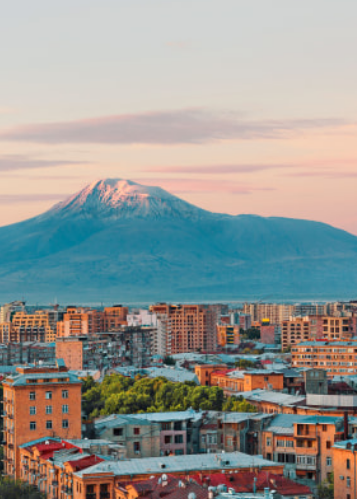
Yerevan, the capital, is built largely from volcanic pink-tuff stone that gives the city a warm, amber tone at sunset that inspired the nickname the Pink City. The café and wine bar culture on Saryan Street is the first impression of a city that turns out to be significantly more interesting than its international profile suggests: serious museums of art, music, film and ancient manuscripts, a jazz scene with multiple dedicated venues, and an evening culture that is genuine rather than performed.

From Yerevan, the route runs as a single loop rather than a series of day trips. South first, to Tatev, the medieval monastery above the Vorotan Gorge reached by the world’s longest reversible cable car. From there north again to Jermuk, a highland spa town in the Vayots Dzor mountains, then onward over the Selim Pass, a genuine Silk Road route with a 14th-century caravanserai still standing at its summit, down to the wide blue expanse of Lake Sevan. From Sevan it’s a short run into the dense, extraordinary-in-autumn forests of the Tavush region, then west across the country to Gyumri, Armenia’s second city, where fin-de-siècle Russian imperial architecture and a creative culture fill in what Yerevan’s rapid modernisation has left behind, before the final run back to the capital.

Highlights

Yerevan's cultural depth

Yerevan's cultural depth

Yerevan is covered in unique sites: The Cascade, the monumental Soviet-era staircase connecting the city centre to the residential hills above, is also an outdoor contemporary art installation: sculptures by Lynn Chadwick, Fernando Botero and others fill the terraced gardens, and the Cafesjian Museum of Art fills the internal escalator levels with one of the best modern art collections in the South Caucasus. The Matenadaran is a repository of over 23,000 ancient manuscripts, the largest collection of medieval Armenian manuscripts in the world, housed in a Soviet neoclassical building above the city. The museums of Saryan, Parajanov, Khachaturian and Komitas between them cover the full range of Armenia's contribution to visual art, film, music and culture in the 20th century.

Tatev Monastery and the Wings of Tatev

Tatev Monastery and the Wings of Tatev

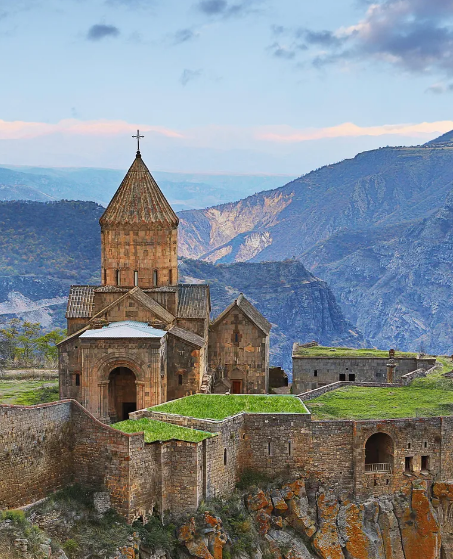
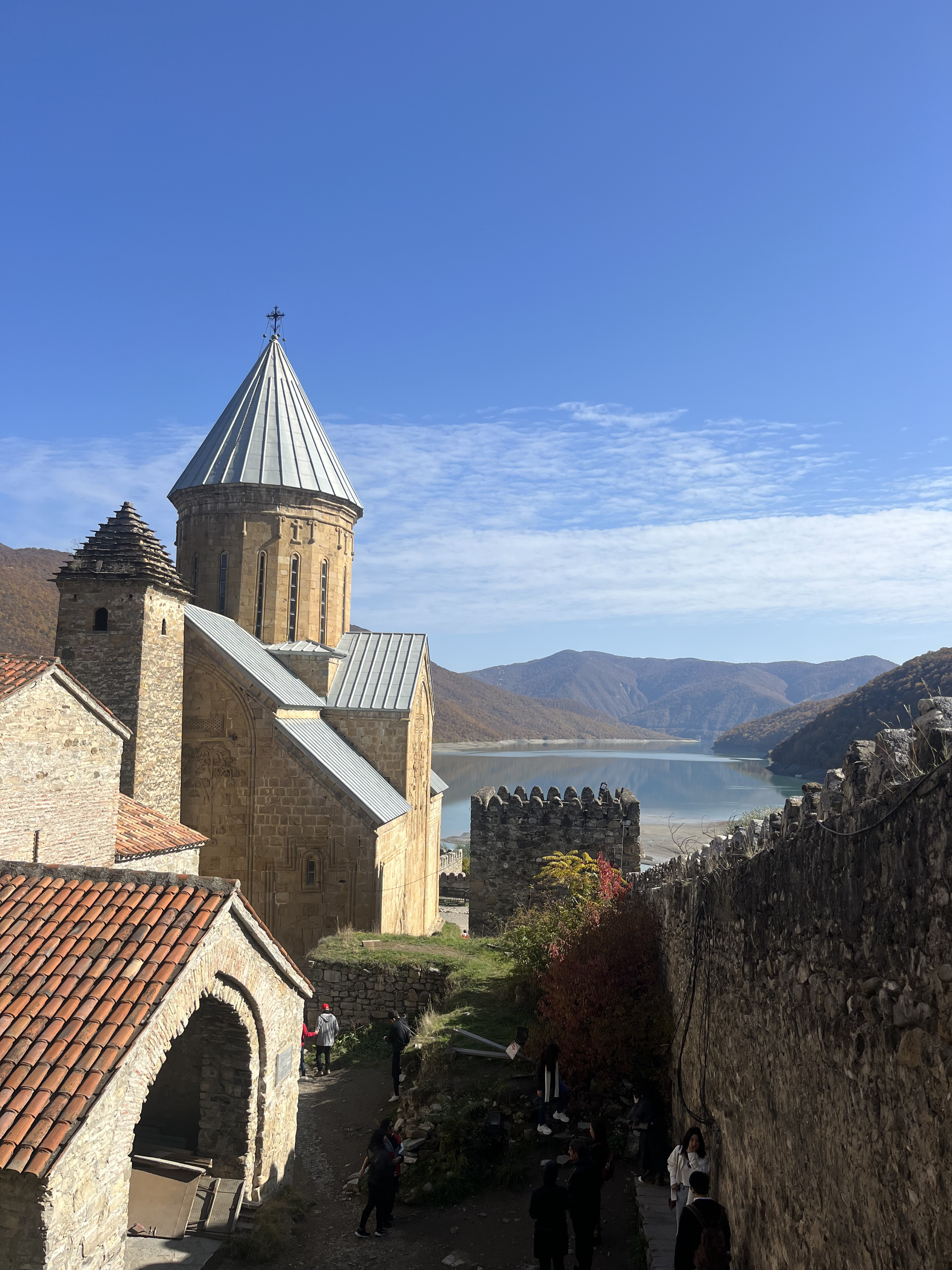
The Wings of Tatev ropeway, the world's longest non-stop double track cable car at 5.7 km, descends 320 metres into the Vorotan Gorge to the 9th-century monastery of Tatev. The monastery occupies a basalt promontory above the gorge with a 300-metre drop on three sides; the setting is one of the most dramatic of any medieval building in the South Caucasus. The interior contains a 9th-century dining hall, a pillar that swings to predict earthquakes, and a library that was one of the most important centres of Armenian learning in the medieval period.

Jermuk

Jermuk

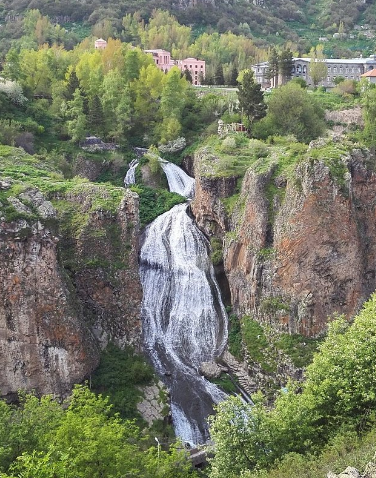
Jermuk sits at 2,080 metres in the Vayots Dzor mountains, a Soviet-era spa resort built around the mineral springs that bubble from the volcanic rock at a constant temperature of 43°C. The springs are the source of Jermuk mineral water, the most exported Armenian product after brandy.

The route

Days 1 to 3: Yerevan / Cascade and Cafesjian Museum, Republic Square, Saryan Street wine bars, museums of art and culture, jazz evenings and classical music

Day 4: Yerevan to Tatev / travel south via the Areni wine region, arrive in the Tatev / Goris area

Day 5: Tatev / Wings of Tatev ropeway, monastery above the gorge and Shaqi Waterfall

Day 6: Tatev to Jermuk / travel north through Vayots Dzor

Day 7: Jermuk / mineral springs, Arpa Gorge walk and Jermuk waterfall

Day 8: Jermuk to Sevan / over the Selim Pass and caravanserai, Sevanavank Monastery and Wishup or Communa beach

Day 9: Sevan to Dilijan / Tavush region, Parz Lake, Haghartsin Monastery

Day 10: Tavush region / Ijevan and Yenoqavan forest walks

Day 11: Dilijan to Gyumri / travel west via Vanadzor, Kumayri Historic District and the Black Fortress

Day 12: Gyumri to Yerevan / return by train, departure or extension

Start the journey

The first part of the day-by-day route, free to read.

Days 1 to 3: Yerevan

Zvartnots International Airport (EVN) is 12 km west of the city centre. GG Taxi is the standard ride-hailing app in Yerevan; download it before landing and use it for all city transport. Always use GG or Yandex for a transparent fare. The city metro runs from the airport toward the centre; useful but limited in coverage.

Yerevan's street grid is organised around Republic Square, the broad Soviet-era centrepiece flanked by the History Museum and the government buildings, and the Cascade, the monumental outdoor staircase that connects the lower city to the residential Kanaker district above. Both are within walking distance of each other and within walking distance of most central accommodation.

The Cascade and Cafesjian Museum: The Cascade is simultaneously an outdoor sculpture park, a contemporary art museum and the city's most significant public space. The staircase itself is lined with works by internationally significant sculptors including Fernando Botero (whose characteristic bronze figures appear at intervals), and the internal escalators pass through gallery levels of the Cafesjian Museum of Art. At the top, the view over the city and toward Mount Ararat on a clear day is the most reproduced Yerevan image.

Republic Square in the evening is where the city congregates: the singing fountains that run between the History Museum and the Marriott, the outdoor café terraces, and the particular evening light on the pink-tuff government buildings. Sit at one of the square-facing cafés after dinner and watch the city's social ritual.

Saryan Street: The central wine and food street of Yerevan, named for the Armenian painter Martiros Saryan. Saryan Street and its immediate vicinity have the best concentration of independent restaurants, wine bars and cafés in the city. In Vino wine bar, Lavash, Sherep and Single Origin Coffee Roasters are all on or immediately adjacent to it. The street is also the correct place for an evening walk.

Museums: The source material lists seven: the National Gallery, the Saryan Museum, the Parajanov Museum, the Aram Khachaturian Museum, the Komitas Museum, the History Museum and the Matenadaran. Three days gives you enough time to visit most of them.

The Matenadaran, the repository of ancient Armenian manuscripts at the top of Mashtots Avenue, is the non-negotiable. It holds over 23,000 manuscripts ranging from 5th-century Gospel books to medieval scientific treatises; the permanent collection covers illuminated manuscripts, historical documents and examples of the Armenian script invented by Mesrop Mashtots in 405 AD. The building itself, a 1959 Soviet neoclassical structure by architect Mark Grigoryan, sits above the city with a monumental front staircase and statues of Mashtots and the historian Koryun.

The Sergei Parajanov Museum covers the life and work of the Armenian-Georgian film director whose films, particularly The Colour of Pomegranates (1969), are among the most significant in Soviet cinema history; the collages and assemblages in the museum give a more direct sense of Parajanov's artistic sensibility than even his films.

Evenings: The source material identifies a specific jazz scene with multiple dedicated venues: Ulikhanyan Club, Pulpulak, Malkhas Jazz Club, Varpet, Vidi and Camilla. Malkhas is the oldest and most established, named for jazz pianist Levon Malkhasyan and still operating under his legacy; the club consistently books live acts and the quality of musicianship is high. Varpet is a more mixed venue that covers jazz alongside cocktails and food.

For classical music: the source material lists the National Opera and Ballet Theatre, the National Symphonic Orchestra, the National Philharmonic and the Komitas Chamber Music Hall. Check the current programme at each before arriving; the season runs October to June and the ticket prices are among the lowest of any major performing arts venue in Europe.

Abovyan Street is the pedestrianised commercial street running north from Republic Square; worth a walk for the bookshops, cafés and the transition from the formal Soviet-era centre into the older residential areas behind it.

Seasons Park (Yeghaniots Park) on the Hrazdan Gorge edge is the best green space in the city, a recent landscaping project above the gorge with walking paths, lookout points and a more relaxed character than the formal parks closer to the centre.

Get the full Armenia itinerary

  • The rest of the day-by-day route, 9 more detailed entries
  • Where to stay, by budget
  • Where to eat and drink
  • Practical reminders and cautions
  • Ways to shorten or extend the trip
  • 8 photos from the trip
  • A direct line to the traveller who led it

£12.99

One-time payment

Unlock this itinerary

Instant access. You'll confirm at checkout that this ends your 14-day right to cancel. Terms

Already bought it? Log in

From travellers on this trip

“I highly reccommend you do this trip as a loop rather than day trips from Yerevan. It completely changed the pace of the country and felt like a proper roadtrip rather than a checklist.”

Yury Tbilisi, Georgia

“Tatev alone justified the whole detour south, but it was the caravanserai at the top of the Selim Pass that stayed with me longest. Nobody else was there. Just stone, wind, and the pass dropping away toward the lake.”

Tristan Paris, France

“The food! Grilled ishkhan at Sevan, khinkali in Dilijan, then Gwoog in Gyumri! Yum!”

Nadia Milan, Italy